
Council of Heads of Australasian Herbaria
Australian National Herbarium
Biographical Notes

|
|
Council of Heads of Australasian Herbaria | |
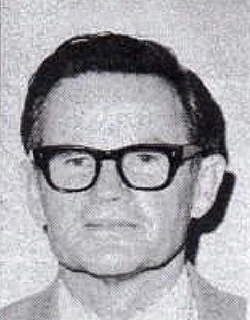 Havel, Jaroslav Joseph (Joe) (1930 - )
Born in 1930 in Czechoslovakia; .
In 1948 a 17-year-old
Jaroslav (Joe) Havel had just endured six years of Nazi occupation
in his home village in Czechoslovakia.
Europe was carved
up and, in 1948, Communism swept
across his country.
Joe planed to escape and he
and a friend began training themselves
in night-walking, mountain-climbing
and sleeping out in the open to prepare
themselves for escape.
On the
Easter weekend they caught a train to the base of
the mountains bordering Germany, and
took flight.
The duo made their way through
a formerly German-inhabited area by
being inconspicuous - they carried no
luggage and spoke to virtually no one.
In the mountains that night they dug into
the snow and awaited the
morning light to get their bearings.
When they
reached the other side of the range
they entered the relative safety of the American-occupation zone in Germany.
Several refugee camps later, and after a
failed bid to travel to Canada, Joe was
told he'd been accepted for
Australia.
After landing at Fremantle
Joe obtained
work as an engine cleaner, then a
timber stacker and, later,
as a member of a forestry gang at
Gleneagle (1949-51).
While working
at Jarrahdale and Gleneagle, he did
his university entrance studies by
correspondence.
Through sheer perseverance, he was eventually
awarded a Commonwealth scholarship.
After two years of science study at
The University of Western Australia,
he went to Canberra, to the
country's only professional forestry
course.
While there he took up a
forestry cadetship in New Guinea.
On completion of his study, Joe
married WA woman Betty Currie,
and then travelled to a small gold
mining town in New Guinea.
He
progressed through a number of jobs,
including
research and regional management.
His research earned him a Master of
Science degree at the University of
Queensland.
On PNG independence, Joe was given the job of
training local foresters. In preparation
for the role, he completed a Diploma
of Education and studied forestry
training in Dwellingup, New Zealand
and Fiji.
On return to New Guinea he
prepared the teaching materials from
scratch and started the Papua New Guinea Forestry College at Bulolo
as its first principal.
After 10
years in New Guinea (1953-1964), Joe and Betty
decided to return to Australia.
Joe
was soon working with the WA Forests
Department investigating how soil
quality affected the growth of pine
plantations.
Joe was later promoted to
inspector and then superintendent
within the Forests Department.
Pressured by the strength of the
environmental movement, forestry in WA
began to fall into decline. The Forests
Department was combined with
Fauna Research and the National
Parks Authority to become the
Department of Conservation and
Land Management, CALM, in 1985, in which Joe was
the Director of Research and Planning.
But Joe, weary from the political
turbulence and years of negotiating,
and recovering from a heart attack,
decided it was time to retire from
government.
Later, he started his own
private consulting firm.
Not one to
ease into retirement, Joe also embarked
on a PhD on the ecology of the forests
of south-western Australia in relation
to climate, landforms and soils, which
he completed at age 70.
Source: Extracted from:
https://sites.rootsweb.com/~gregheberle/AdobePDF/Forestry-Personnel-PDFs/Havel,%20Jaroslav%20Joseph.pdf
https://library.dbca.wa.gov.au/static/Journals/080052/080052-27.01.pdf
LANDSCOPE, Volume 27 Number 1 SPRING 2011, p.25
Portrait Photo: https://sites.rootsweb.com/~gregheberle/AdobePDF/Forestry-Personnel-PDFs/Havel,%20Jaroslav%20Joseph.pdf
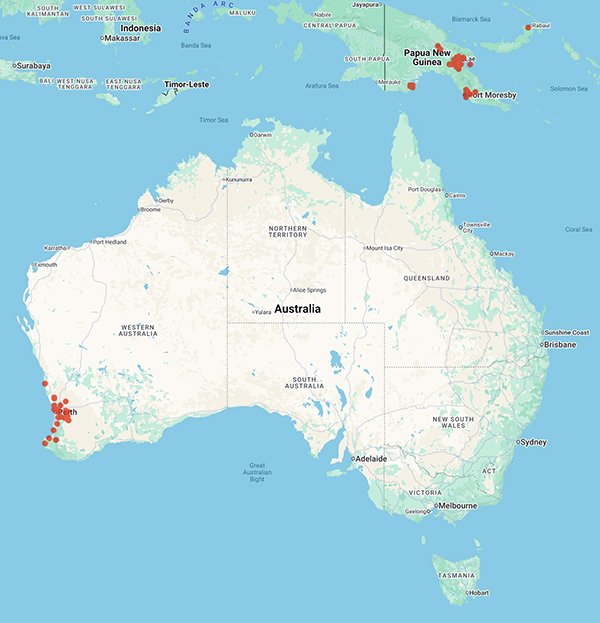
Data from 868 specimens