
Council of Heads of Australasian Herbaria
Australian National Herbarium
Biographical Notes

|
|
Council of Heads of Australasian Herbaria | |
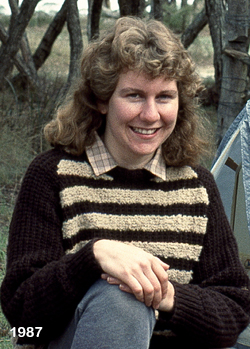 Beckman, Karen G. (fl.1990s-2000s)
She completed her undergraduate degree at Monash University and went on to do an Honours degree under Dr George Scott.
Her Honours Thesis was titled; "The Biology of Lethocolea squamata".
In August 1989 she gave a talk to the Victorian chapter of ASBS on 'Aspects of the biology and taxonomy of marsupial liverworts'.
In 2002 she published "Bastow's Tasmanian Hepaticae" translating his original illustration captions into modern nomenclature.
In 2004-05 she was awarded a ABRS grant of $17,000 to undertake a "Bryophytes, A flora treatment of the family Ricciaceae" in collaboration with Prof. R.Seppelt, – completion of this treatment is being finalised by Chris Cargill incorporating molecular data.
She was joint author, with Chris Cargill and Rod Seppelt of "Taxonomic revision of Riccia (Ricciaceae, Marchantiophyta) in the monsoon tropics of the Northern Territory, Australia" in 2021.
She has been commended as a botanical artist: "... Karen Beckman's work
differs too, in that she combines her artistic talents and her
botanical training, so that her Frullania clavata includes
both a coloured image of the whole plant in its natural habitat and microscopic technical detail in pencil."
In 2026 she was working for Healesville Sanctuary, part of Zoos Victoria, as their Communications Officer.
Source: Extracted from:
https://bryology.org/wp-content/uploads/2019/01/Bryological-Times-2011-134.pdf
https://www.dcceew.gov.au/sites/default/files/documents/abrs-biologue-29.pdf
Austral. Syst. Bot. Soc. Newsletter No.59, (June 1989).
MELBOURNE CHAPTER PROGRAM FOR 1989
Karen Beckmann (2002) 'Bastow's Tasmanian Hepaticae', Australasian Bryological Newsletter Number 45 May 2002
Alison Downing (2011), 'Bryophytes and scientific illustration' in Bryological Times, 2011, No.134
https://bryology.org/wp-content/uploads/2019/01/Bryological-Times-2011-134.pdf
Pers.Comm. emails C.Cargill-M.Fagg.
Portrait Photo: 1987, Bruce Fuhrer, ANBG Photo Collection.
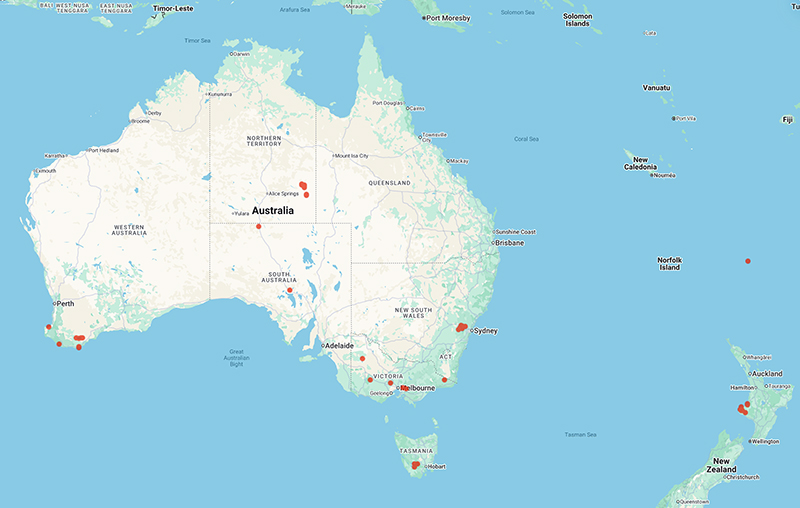
Data from 478 specimens